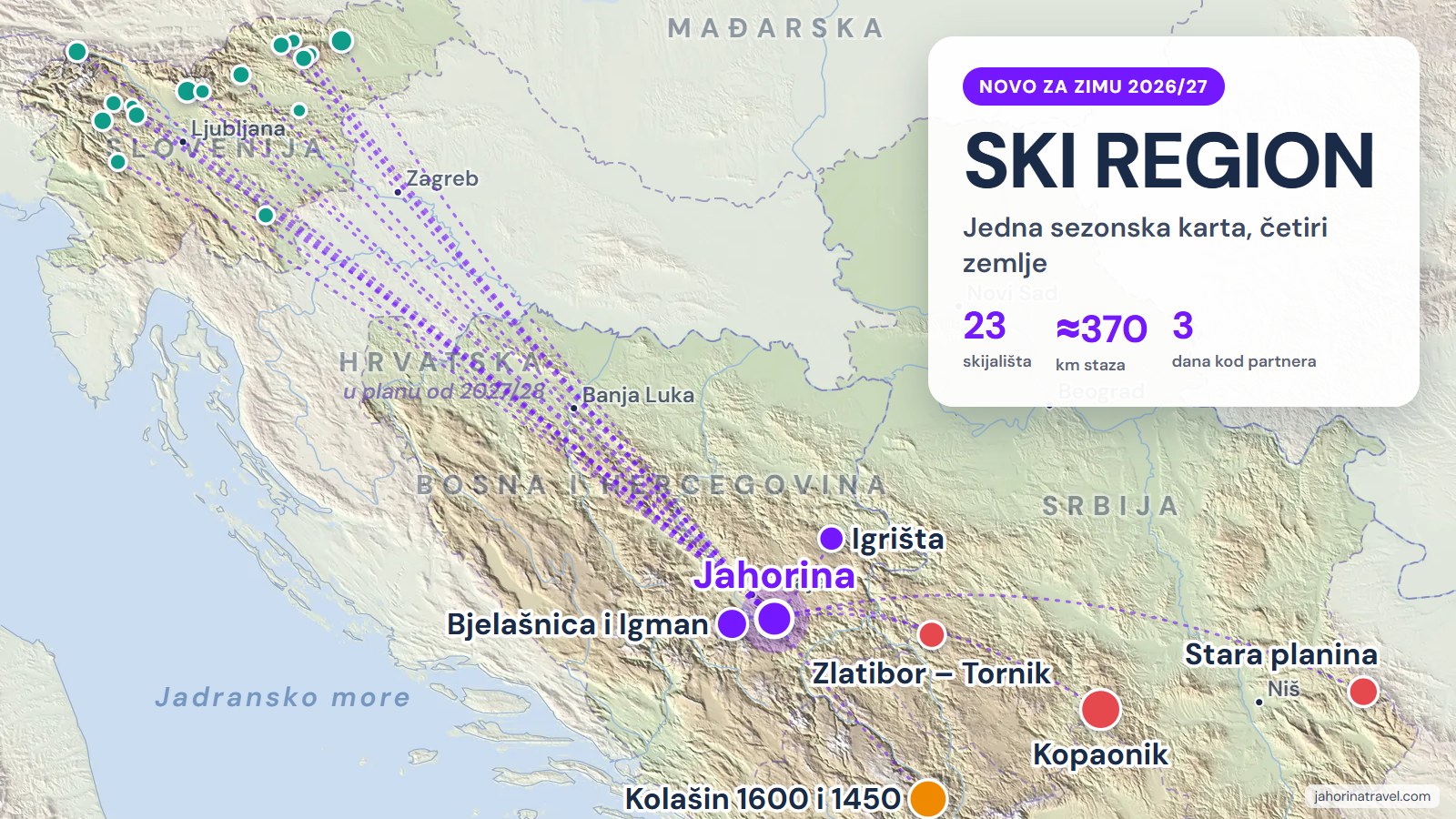
This winter a Jahorina season ski pass is worth far more than one mountain. Under the SKI REGION agreement, signed on Jahorina on 19 November, season pass holders can ski for three days at partner resorts in Bosnia and Herzegovina, Serbia, Montenegro and Slovenia. The map includes 23 ski resorts and about 370 kilometres of slopes.
The resorts agreed to recognise each other’s season passes. It works both ways: a Jahorina skier can go to Bjelašnica, Kopaonik or Krvavec, and season pass holders from those resorts can come to Jahorina. On the map below, every resort sits at its real location. Hover over or tap a point to see the length of the slopes, the altitude and the drive from Jahorina.
SKI REGION: where your season pass works
Hover over or tap a ski resort. Each pin sits at the resort's real location.
- 4countries
- 23ski resorts
- ≈370km of slopes
- 3days at partner resorts
Bosnia and Herzegovina
Jahorina
Starting point: a Jahorina season pass opens up the whole region
- Slopes
- 52 km
- Altitude
- 1,300–1,890 m
- Lifts
- 18
- Drive from Jahorina
- home resort
All resorts
Bosnia and Herzegovina
Serbia
Montenegro
Slovenia
Relief: SRTM elevation data (AWS Open Data); borders and rivers: Natural Earth. Slopes, altitude and lifts: skiresort.com, November 2026. Drive times are rough estimates by car without breaks. Resort list: OC Jahorina, 19 November 2026.
Who is in the agreement
The agreement was signed by the Olympic Centre Jahorina, KJP ZOI’84, which runs Bjelašnica and Igman, Skijališta Crne Gore (Montenegro’s ski resorts company) and the Slovenian Ropeway Association, on behalf of 16 Slovenian resorts. The map published by OC Jahorina also includes Kopaonik, Zlatibor and Stara Planina, run by the Serbian company Skijališta Srbije.
- Bosnia and Herzegovina: Jahorina, Bjelašnica and Igman, Igrišta near Vlasenica
- Serbia: Kopaonik, Zlatibor (Tornik), Stara Planina
- Montenegro: Kolašin 1600 and 1450
- Slovenia: Krvavec, Velika Planina, Kranjska Gora, Soriška Planina, Cerkno, Rudno, Stari Vrh, Javornik, Gače, Ribnica na Pohorju, Mariborsko Pohorje, Jakec Trije Kralji, Rogla, Kope, Golte and Celjska Koča
On the same map Croatia carries the note “season 2027/2028”, so the region could grow as soon as next winter.
This is not the first deal of its kind. Last winter Jahorina and Skijališta Srbije introduced three free days for season pass holders on each other’s mountains. SKI REGION extends the same model to four countries.
What it is worth
Three days of skiing add up. This season a day pass costs €50 in Kranjska Gora, €49 at Rogla, €43 in Cerkno and €35 at Stari Vrh. Three days in Kranjska Gora are worth about €150, and three days at Rogla €147. We checked these prices for our article on the start of the 2026/27 ski season.
According to the official price list, an adult Jahorina season pass costs from 1,250 KM for weekdays to 2,500 KM for the whole week with night skiing. If you ski all winter anyway, you now also have a reason for a few trips beyond Jahorina.
What we don’t know yet
The signatories have announced the basis of the agreement, but not the detailed rules. Until the official terms are out, these questions remain open:
- whether the three days count per resort or per country,
- whether the days must be announced or booked in advance,
- whether weekday-only season passes also qualify,
- whether there are blackout dates, such as holidays.
Until the rules are published, call the ticket office of the resort you are heading to before your trip, and bring your season pass and an ID. The obvious point matters too: the benefit only works once the resorts are open, and the start of the season everywhere depends on snow. We will update this article when the signatories publish the details.
Where to go with a Jahorina season pass
You know the slopes on Jahorina. Here is what the partner mountains offer that is different, and who each of them suits.
Bjelašnica and Igman: a different mountain an hour away
The nearest partner is an hour’s drive from Jahorina, with completely different terrain. Bjelašnica rises to 2,067 metres, the highest of all resorts in BiH, and is open above the tree line. The men’s alpine events of the 1984 Olympics were held here. For a Jahorina skier it is the easiest trip: leave in the morning, ski all day and be home in the evening. Igman has a smaller slope and the Olympic ski jumps.
Kopaonik: Serbia’s biggest ski resort
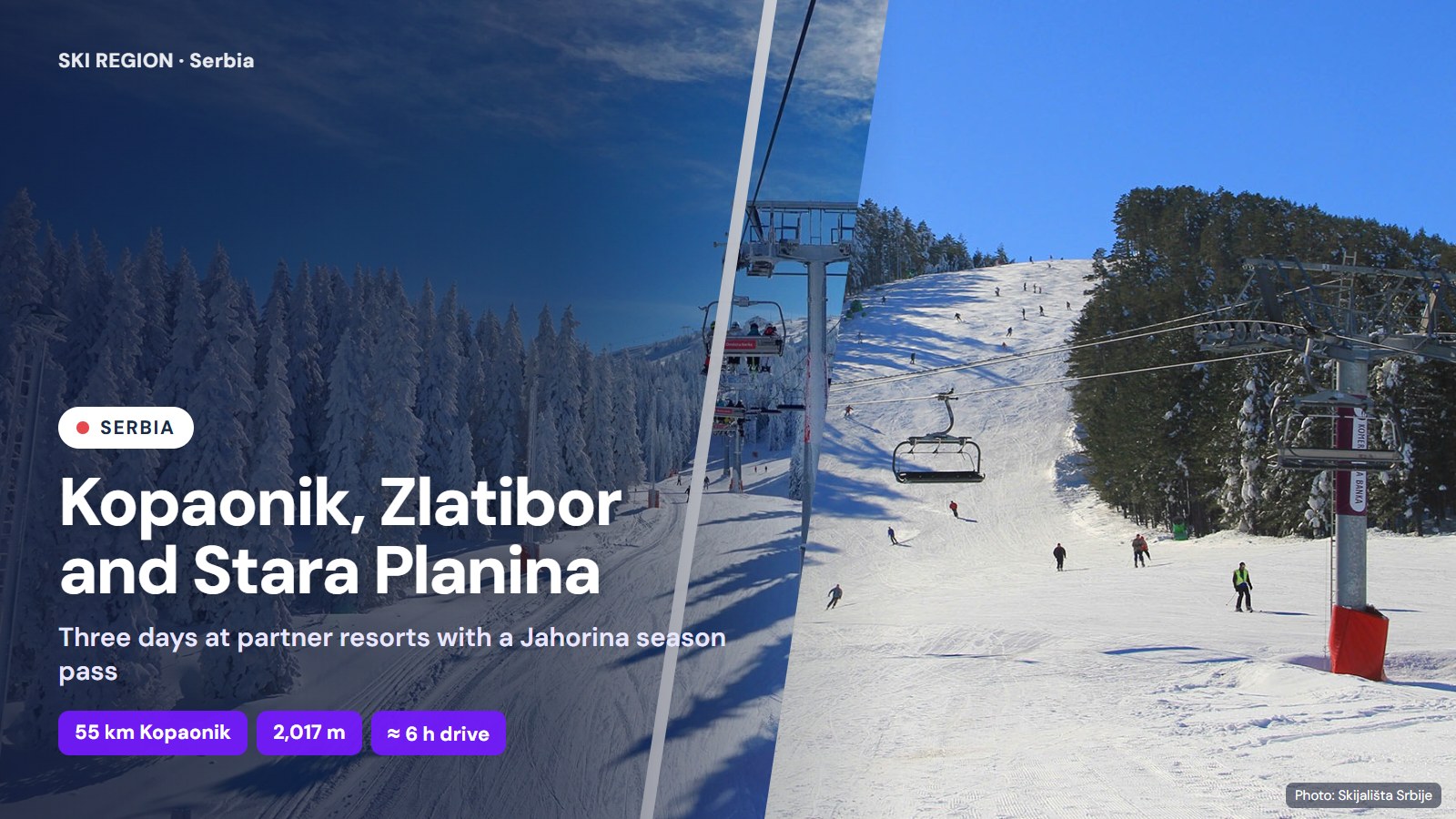
Kopaonik has about 55 kilometres of slopes and 26 lifts, with the top at 2,017 metres. It is about six hours’ drive from Jahorina, so it is a real long-weekend destination. Three days are just enough to cover the main runs, from wide blues to steeper blacks. Kopaonik also has an extensive snowmaking system.
Zlatibor and Stara Planina: family-friendly and uncrowded
Zlatibor is the nearest resort outside BiH, about three hours from Jahorina via Višegrad. From the centre of Zlatibor you can ride the Gold gondola, about nine kilometres long and one of the longest panoramic gondolas in the world, up to Tornik. The slopes on Tornik are shorter, about seven kilometres, and good for families and beginners.
Stara Planina is in the far east of Serbia, about eight hours’ drive from Jahorina. The Babin Zub resort has about 13 kilometres of slopes and fewer crowds than the big centres. It suits those who combine skiing with a longer trip.
Kolašin: skiing up to 2,072 metres
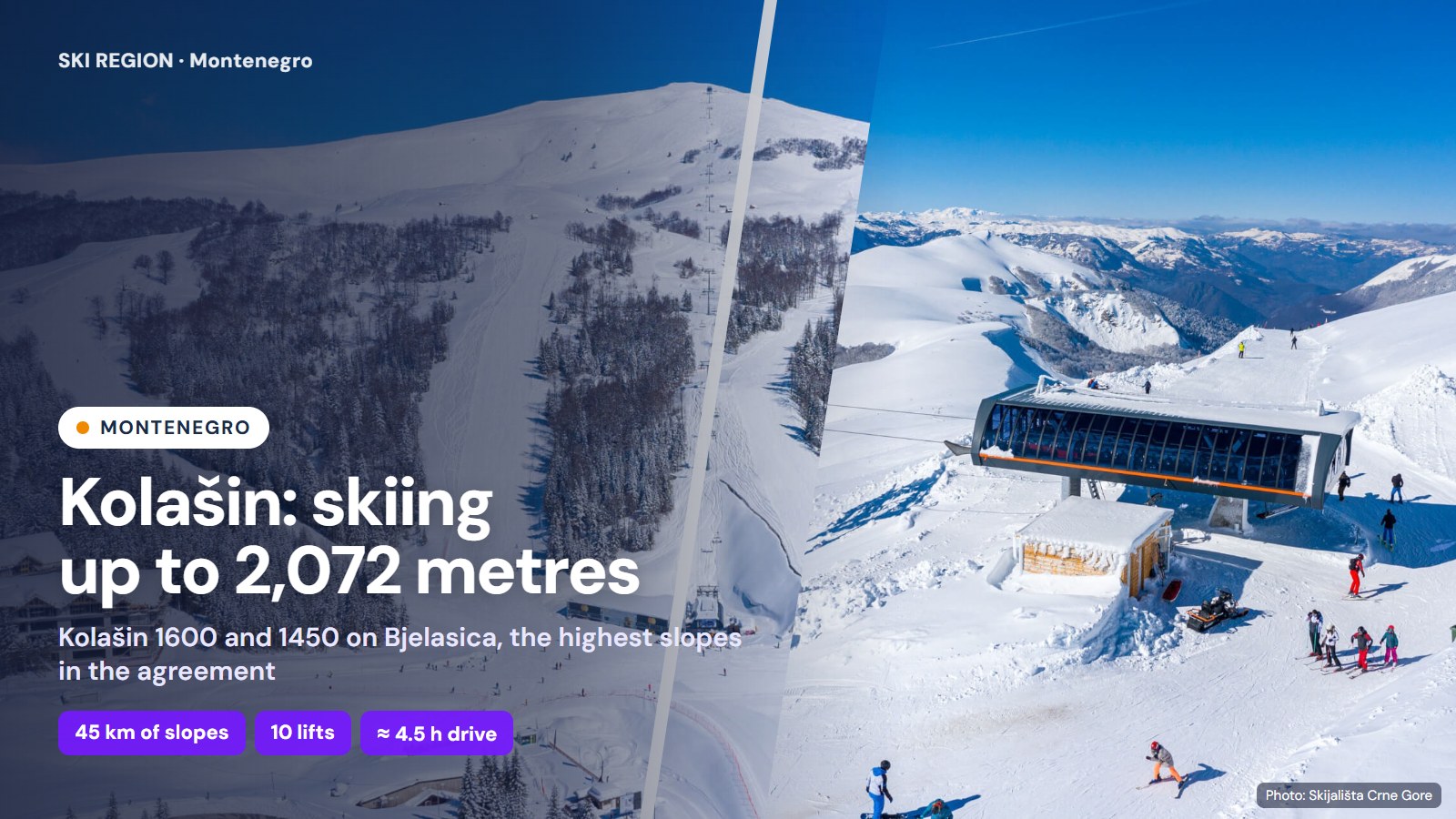
Kolašin 1600 and Kolašin 1450 on Mount Bjelasica together have about 45 kilometres of slopes and ten lifts. The top at 2,072 metres is the highest point of all resorts in the agreement. Most of Kolašin 1600 lies within Biogradska Gora National Park, so you ski through untouched forest with views of the Bjelasica peaks. The drive from Jahorina takes about four and a half hours, via Goražde and Pljevlja.
Slovenia: 16 resorts, from Pohorje to the Julian Alps
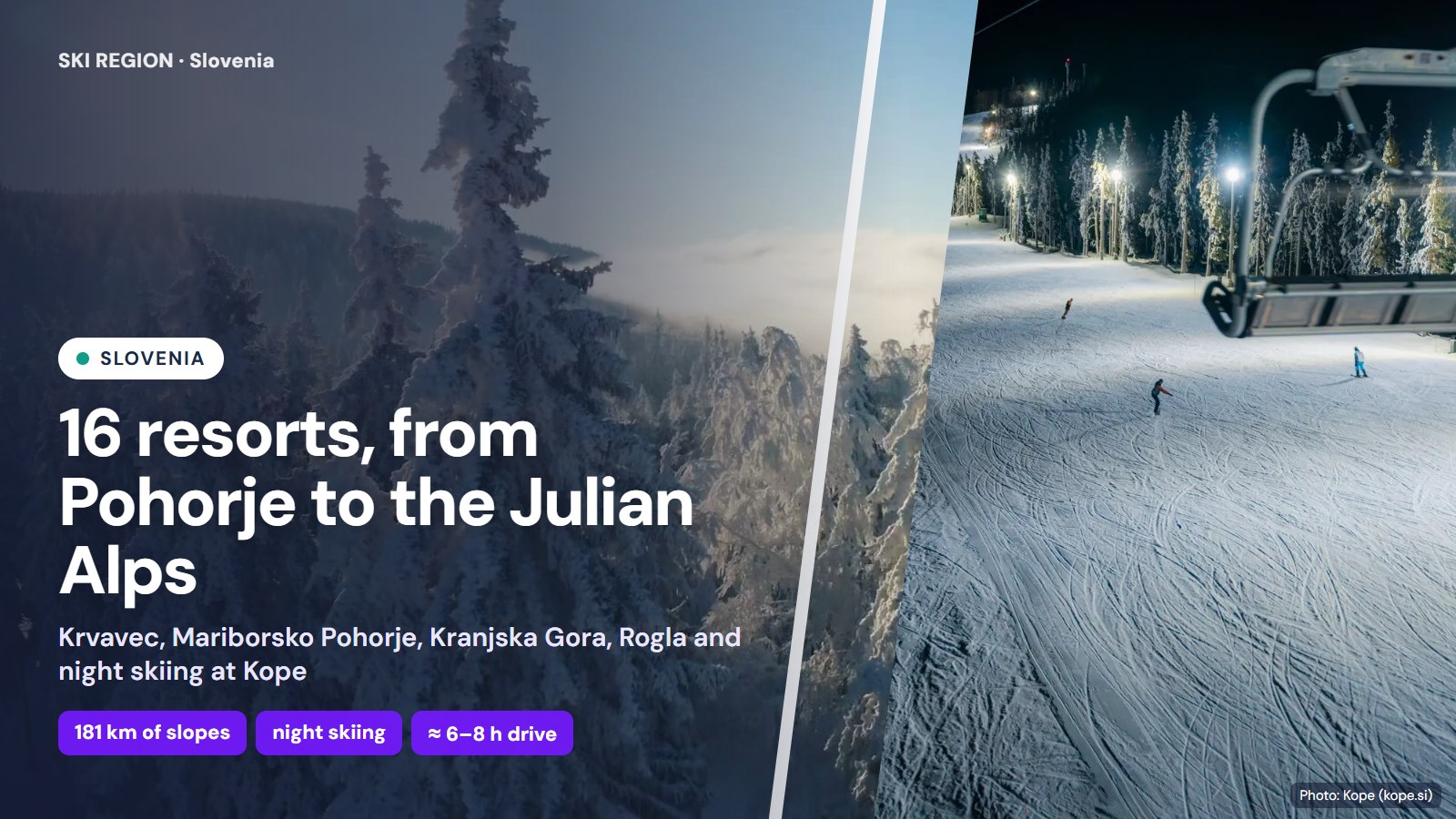
Slovenia brings the most resorts to the agreement, with about 180 kilometres of slopes in total. The drive to the Slovenian mountains takes six to eight hours, so they are best for a few days with accommodation. If you have to choose, these are the ones worth trying:
- Krvavec, about 30 kilometres of slopes and a top at 1,971 metres, some fifteen minutes from Ljubljana airport. The biggest resort near the capital.
- Mariborsko Pohorje, about 35 kilometres of slopes above Maribor. It hosts the women’s World Cup “Golden Fox”, and the slopes are lit for night skiing.
- Kranjska Gora, slopes that host the men’s World Cup, right next to the Planica ski jumps.
- Rogla, Kope and Jakec Trije Kralji on Pohorje, several resorts within an hour of each other. Kope also has night skiing.
- Velika Planina, a small resort above Kamnik, known for its herders’ village of wooden huts.
If it turns out that the three days count per resort, a week on Pohorje could be built from several mountains without buying day passes.
Before you travel in the region
- Winter equipment: mandatory in BiH from 1 November. Serbia, Montenegro and Slovenia also require winter tyres and chains, so check them before you leave.
- Documents: BiH citizens need only an ID card for Serbia and Montenegro. Slovenia is in the EU, so you need a passport, and biometric data is taken at the border, so expect waiting.
- Tolls: Slovenian motorways require an e-vignette, and the route through Croatia has tolls.
- Snow: check that the resort is open before you leave. For Jahorina, follow our weather forecast.
For skiers from the region this is also an invitation to Jahorina. A season pass holder from Kopaonik or Krvavec can spend three days on the Olympic slopes where all this began.